Build a local-first agent stack
An agent workflow does not have to become a hosted application just because it needs durable context. A useful local stack separates four jobs: the MCP client decides what to do, file.cheap owns artifact lifecycle, veclite retrieves saved files, and optional local model tools add semantic retrieval.
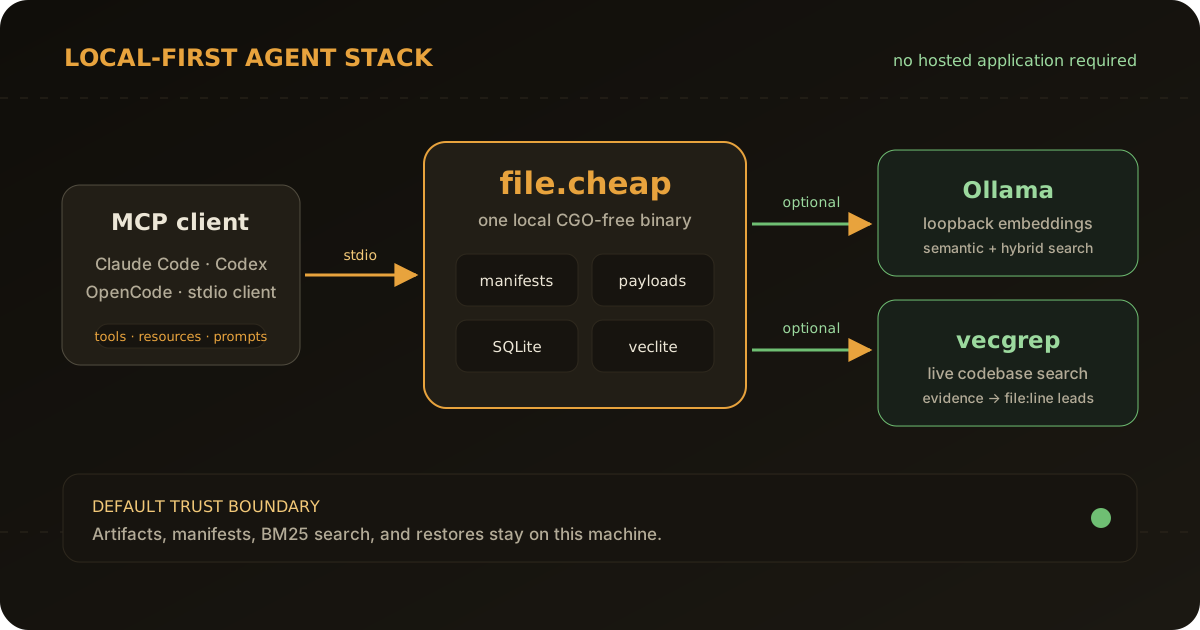
The default path stays inside one machine. Network access appears only when you configure a remote embedder or independently copy a stash somewhere else.
A versioned fcheap-local artifact reference can cross process or product boundaries as metadata, but it does not change that network boundary. The reference resolves only where its source vault exists.
The pieces
MCP client
Claude Code, Codex CLI, OpenCode, or another stdio MCP client launches fcheap mcp serve. It can call 15 typed tools, read stash resources, and use investigation prompts. The client never needs direct access to the vault layout.
file.cheap
The single CGO-free Go binary saves immutable snapshots, records provenance, scans for likely secrets, compresses large payloads, verifies restores, and manages retention. Its local manifest remains the portable source of truth.
SQLite and veclite
SQLite is a queryable write-through index over manifests; it self-heals from the on-disk stash directories. veclite keeps one search document per saved file and provides BM25 without a model. Both indexes are derived local state, so they can be rebuilt rather than treated as irreplaceable payloads.
Ollama, optional
A loopback Ollama endpoint adds semantic vectors while keeping document and query text on the machine. OpenAI and non-loopback Ollama endpoints are also supported, but they expand the privacy boundary.
vecgrep, optional
file.cheap searches saved evidence. vecgrep searches a live codebase. The connect command bridges them by extracting a query from a stash and returning ranked source file:line candidates. vecgrep remains a separately installed runtime dependency.
Assemble the stack
Install file.cheap and check its runtime:
brew install --cask --no-quarantine abdul-hamid-achik/tap/fcheap
fcheap doctor
Register the MCP server with your client using the copy-paste configurations. BM25 needs no further setup. To add local semantic search:
fcheap config set embedder ollama
fcheap config set ollama_url http://127.0.0.1:11434
fcheap config set embed_model nomic-embed-text
Then save and index an artifact:
fcheap save /tmp/agent-evidence --tool vidtrace --tag repro --index
fcheap search 'where the table stopped updating' --mode hybrid
Keep the boundaries honest
- The vault contains payloads and manifests; do not make a derived search index the only copy of anything.
- A save-time secret warning is a review aid, not a guarantee that content is safe to transmit.
- Loopback Ollama is local. OpenAI and non-loopback Ollama send indexed text and queries over the network.
connectreturns likely code ownership, not confirmed causality.- Local-first is not the same as backed up. Valuable evidence still needs an independently designed recovery policy.
This shape stays small because every component has one job. Start with BM25 and the MCP server; add Ollama only when paraphrase search improves real work, and add vecgrep only when connecting evidence to source code is a repeated need.
Next, compare BM25, semantic, and hybrid search or follow the local artifact reference integration.